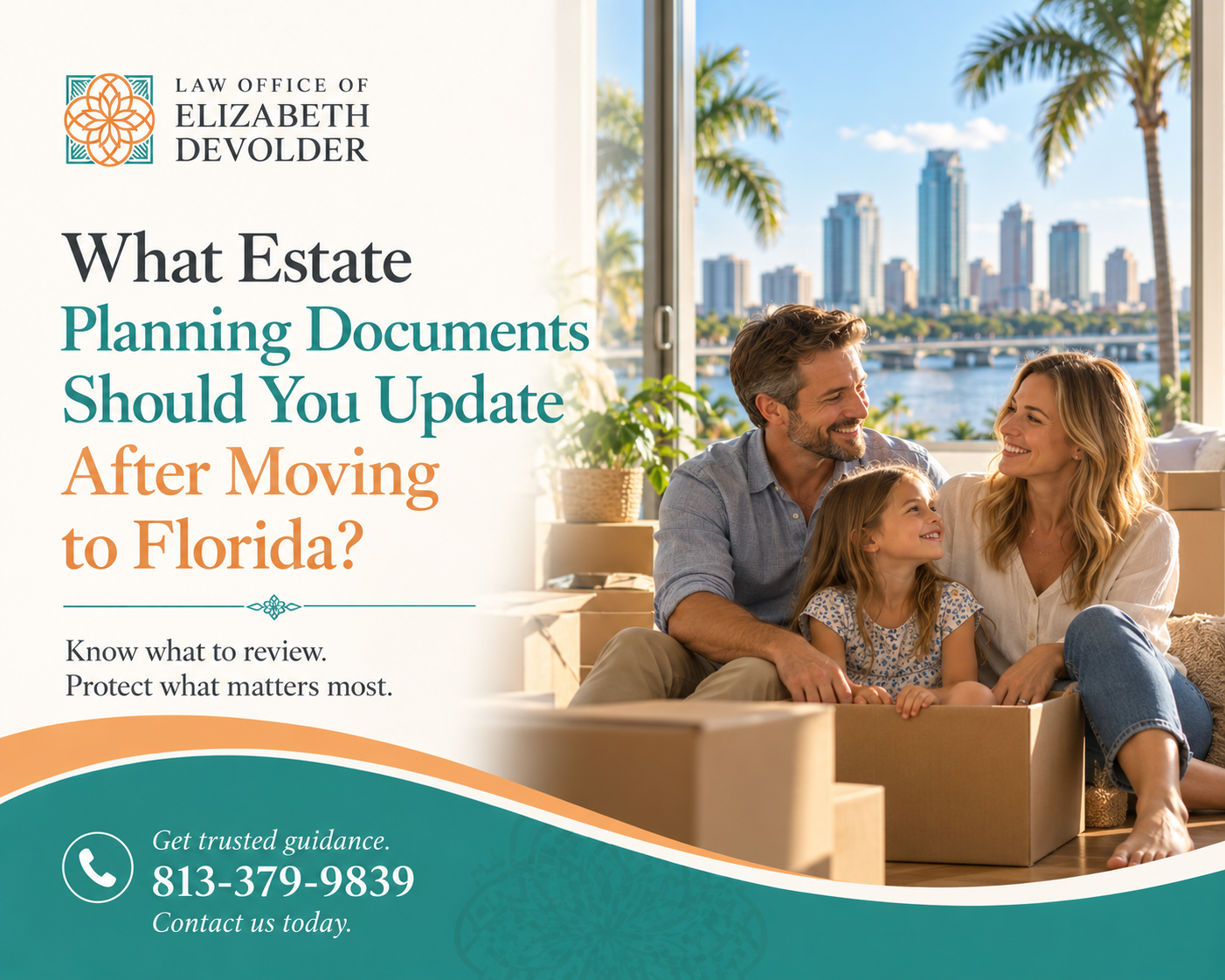
However, moving to Florida is an important reason to review your will, trust, power of attorney, and healthcare directives. Even if these documents were legally prepared in another state, they may not fully address your current circumstances or Florida's specific legal requirements.
At the Law Office of Elizabeth Devolder, we help individuals and families in Tampa, Sarasota, and surrounding Florida communities understand their estate planning options and make informed decisions about protecting their loved ones.
If you've recently relocated, our estate planning services can help you determine which documents need attention and whether updates are appropriate.
Do You Need to Update Your Estate Plan After Moving to Florida?
Not necessarily. Moving to Florida does not automatically invalidate your existing estate planning documents.Florida generally recognizes certain legal documents properly executed in other states. However, recognizing a document as valid does not necessarily mean it is the most practical or appropriate document for your current needs.
Different states have different laws regarding property ownership, inheritance, financial decision-making, and healthcare planning.
For example, a will created in another state may still be legally valid in Florida, but its provisions might not account for Florida homestead protections. Similarly, an older power of attorney might not give your chosen agent the authority needed to handle certain transactions.
The goal is not necessarily to replace every document. It is to make sure your estate plan continues to work for you and your family.
1. Review Your Last Will and Testament
Your last will and testament explains how you want certain assets distributed after your death and allows you to nominate a guardian for minor children.Under Florida Statute §732.502, a will executed by a nonresident outside Florida may be recognized if it was valid under the laws of the place where it was executed, subject to certain exceptions, including holographic and nuncupative wills.
Still, relocating presents a good opportunity to review your will, particularly if:
- You purchased a home or other property in Florida.
- Your family circumstances have changed.
- Your chosen personal representative lives in another state.
- You want to update beneficiaries or distribution instructions.
- Your will was prepared several years ago.
Why Florida Homestead Laws Matter
Florida has specific protections governing a qualifying primary residence. These laws can affect how a home passes to surviving spouses and minor children.For example, Florida Statute §732.4015 limits how certain homestead property can be transferred at death when the owner is survived by a spouse or minor child.
If you recently purchased a Florida home, reviewing your will can help identify whether your existing instructions align with the state's requirements.
Learn more about preparing a Last Will and Testament with the Law Office of Elizabeth Devolder.
2. Examine Your Durable Power of Attorney
A durable power of attorney allows someone you trust to handle specified financial or legal matters on your behalf, depending on the authority granted in the document.This can be especially important if you become unable to manage your affairs due to illness or incapacity.
Florida recognizes certain powers of attorney properly executed in other states under Florida Statute §709.2106. However, questions about the document's validity, the authority granted, or its acceptance by financial institutions may still arise.
When reviewing an existing power of attorney, consider:
- Does it clearly identify the person you want handling your finances?
- Does the document grant the authority your agent may need?
- Are your chosen agent and any successors still appropriate?
- Does it address your current assets and financial arrangements?
- Could provisions drafted under another state's laws create practical complications?
Recently moved to Florida? The Law Office of Elizabeth Devolder can help you review your existing estate planning documents and determine whether updates would better support your needs.
Contact our office to schedule an estate planning consultation.
3. Review Your Revocable Living Trust
If you established a revocable living trust before moving, you may not need to create an entirely new one.A trust created in another state may continue to operate after relocation. However, reviewing its terms and administration provisions is important, particularly when your residency, assets, or family circumstances have changed.
Questions worth addressing include:
- Does the trust contain provisions that should be updated for Florida residency?
- Should the successor trustee or other designated individuals change?
- Have you properly transferred newly acquired assets into the trust?
- Does the trust address your Florida residence?
- Are the beneficiaries and distribution instructions still accurate?
Our firm can help you understand your options for revocable living trusts and how they fit into your overall estate plan.
4. Update Your Healthcare Surrogate Designation and Living Will
Healthcare planning documents deserve special attention after moving to a new state.In Florida, a designation of healthcare surrogate allows you to appoint someone to make healthcare decisions as authorized by the document and applicable law. A living will provides instructions about specified medical treatment decisions under qualifying circumstances.
People relocating from other states may be familiar with terms such as "medical power of attorney" or "healthcare proxy."
Florida recognizes qualifying advance directives executed in other states under Florida Statute §765.112. Still, reviewing existing documents can help clarify whether they reflect your current wishes and identify the people you trust to make decisions.
Consider updating your healthcare planning documents if:
- Your designated healthcare decision-maker no longer lives nearby.
- You want to appoint a different person or alternate.
- Your medical preferences have changed.
- You have developed new healthcare needs.
- Your documents are difficult for family members or providers to locate.
Explore our Advance Healthcare Directive services to learn more.
5. Check Beneficiary Designations and Property Ownership
Not everything you own necessarily passes through your will or trust.Retirement accounts, life insurance policies, and certain financial accounts often transfer according to beneficiary designations or other ownership arrangements.
After relocating, take time to review:
- Life insurance beneficiaries.
- IRA and 401(k) beneficiary designations.
- Payable-on-death and transfer-on-death arrangements.
- Jointly owned financial accounts.
- Real estate deeds and ownership arrangements.
For example, if a beneficiary designation still names a former spouse or deceased family member, the result could differ from what your updated will provides, subject to applicable law.
Similarly, the way you own your Florida home may affect what happens to the property after your death.
An estate planning review can identify areas where your existing documents and asset arrangements may need better coordination.
When Is the Best Time to Review Your Estate Plan After Moving?
Ideally, review your documents soon after establishing your Florida residence rather than waiting for an emergency.You should also consider another review following significant life events, including marriage, divorce, the birth of a child, retirement, a substantial change in assets, or the death of someone named in your documents.
You do not have to know exactly what needs to be changed before contacting an attorney. Part of the estate planning process is identifying which documents remain suitable and where changes may be beneficial.
For additional guidance, explore our Florida Estate Planning Checklist.
Frequently Asked Questions About Estate Planning After Moving to Florida
1. Is my will from another state valid in Florida?
A will properly executed in another state may be recognized in Florida, subject to statutory exceptions. However, an attorney should review whether its provisions work as intended under Florida law, particularly when homestead property or family circumstances are involved.2. Do I need a new power of attorney when I move to Florida?
Not always. Florida recognizes certain powers of attorney validly executed in other states. However, reviewing your document can help determine whether it grants the authority needed for your current circumstances and whether practical acceptance issues may arise.3. Can I keep my living trust after moving to Florida?
Often, yes. Relocating does not automatically require you to replace an existing living trust. An attorney can evaluate its terms, governing law, successor trustee provisions, and funding to determine whether updates would be appropriate.4. Does Florida recognize medical powers of attorney from other states?
Florida generally recognizes advance directives executed in accordance with the law of the state where they were created or Florida law. Reviewing your documents can help ensure they clearly communicate your medical preferences and identify the appropriate decision-makers.5. Do I need to update my estate plan if I bought a house in Florida?
Buying a Florida home is a good reason to review your estate plan. Florida homestead laws and property ownership arrangements may affect how the property can pass to your beneficiaries.6. How often should I update my estate planning documents in Florida?
There is no universal schedule requiring every estate plan to be updated at set intervals. A review every few years and following major life changes can help determine whether your documents still reflect your circumstances and wishes.7. Should I hire a Florida estate planning attorney if I already have a will and trust?
A Florida estate planning attorney can review documents prepared elsewhere, identify state-specific considerations, and explain whether amendments or additional documents may be helpful. You may discover that some existing documents remain appropriate while others would benefit from updates.Start Your Next Chapter in Florida With an Estate Plan That Fits Your Life
Moving to Florida is an opportunity to build a new chapter, and your estate plan should reflect the life you're building.Whether you have an existing will, an established trust, or financial and healthcare documents prepared in another state, reviewing them now can provide greater clarity about your options and help your loved ones understand your wishes.
At the Law Office of Elizabeth Devolder, we help individuals and families in Tampa, Sarasota, and surrounding communities navigate estate planning decisions with thoughtful, personalized guidance.
You don't necessarily need to start over. You need to know that the documents you already have still meet your needs.
Contact the Law Office of Elizabeth Devolder to schedule an estate planning consultation and discuss whether your documents should be reviewed or updated.
This article is intended for general educational purposes and does not constitute legal advice. Estate planning requirements depend on individual circumstances.