
Blog

All Law Office of Elizabeth Devolder Service Estate Planning Probate
Estate planning attorney helping Florida family plan a special needs trust for a young beneficiary
in Estate Planning

How Can You Provide Long-Term Support for Young Beneficiaries in Florida?

Planning for what happens to your assets after you are gone is about more than simply deciding who receives your property. Many parents and grandparents want to make sure their children, grandchildren, or other young beneficiaries receive meaningful support while also having the guidance and protection they need to make responsible financial decisions. Planning for what happens to your assets after you are gone is about more than simply deciding who receives your property. Many parents and grandparents want to make sure their children, grandchildren, or other young beneficiaries receive meaningful support while also having the guidance and protection they need to make responsible financial decisions. At Elizabeth Devolder, we help families throughout Tampa, Sarasota, and Central Florida create personalized estate plans designed around their unique goals. If you have questions about protecting a young beneficiary through a trust or other estate planning tool, call 813-379-9839 or contact us to schedule a consultation. more Why Should You Avoid Leaving Assets Directly to a Young Beneficiary? Many people assume that leaving money directly to a child or young family member is the simplest option. However, a direct inheritance can create challenges that may not align with your wishes. A minor child generally cannot legally manage inherited assets on their own. If a child receives property or money directly, the court may need to appoint someone to manage those assets through a guardianship proceeding. This process can: Create additional legal expenses Delay access to inherited assets Require court oversight Place decisions about the inheritance outside your direct control Even after a child reaches adulthood, receiving a large inheritance all at once may create unexpected challenges. An 18-year-old or young adult may not have the financial experience or maturity needed to manage a significant amount of money without guidance. A thoughtful estate plan allows you to decide how your assets are managed and distributed rather than leaving those decisions entirely to the court system. How Can a Trust Protect a Young Beneficiary’s Future? One of the most effective ways to provide long-term support for children or young beneficiaries is through a trust. A trust is a legal arrangement that allows you to name someone you trust to manage assets according to your instructions. This person, known as a trustee, has a responsibility to manage and distribute the trust assets based on the rules you establish. Through a trust, you can decide: Who manages the assets How money can be used When beneficiaries receive distributions Whether funds are provided gradually or at specific milestones For example, you may choose for a beneficiary to receive portions of their inheritance at certain ages, such as 25, 30, or 35, rather than receiving everything immediately. A trust can also allow funds to be used for important needs, including: Education expenses Medical care Housing assistance Transportation Other needs you identify in your estate plan Learn more about creating a trust that protects your family's future through Elizabeth Devolder’s trust administration resources. If you are unsure whether a trust is the right option for your family, call 813-379-9839 or contact us to discuss your goals. Special Needs Trusts for Young Beneficiaries With Disabilities Families with a child or young relative who has a disability may need additional planning considerations. A special needs trust can provide financial support while helping protect eligibility for certain government benefits, including programs such as Supplemental Security Income (SSI) and Medicaid. A properly designed special needs trust may allow funds to be used for expenses such as: Medical care Therapy Education Transportation Personal assistance Quality-of-life improvements Because special needs planning can involve complex rules, families should carefully consider how assets are structured. Elizabeth Devolder helps families understand their options and create plans designed around the long-term needs of their loved ones. You can learn more about these planning options by reviewing resources about estate planning and speaking with our office at 813-379-9839. Choosing the Right Person to Manage Your Child’s Inheritance Selecting the right trustee is one of the most important decisions when creating a trust for a young beneficiary. The trustee should be someone who: Understands your values Can manage financial responsibilities Will make decisions based on the beneficiary’s best interests Is trustworthy and dependable Some families choose a relative, while others select a professional trustee depending on the complexity of the estate. It is also important to name a backup trustee in case your first choice is unable to serve. A carefully selected trustee helps ensure your wishes continue to guide your beneficiary’s financial future. Review and Update Your Estate Plan as Your Family Changes Creating an estate plan is an important first step, but keeping it updated is just as important. Your plan should be reviewed after major life events, including: Births or adoptions Deaths in the family Marriage or divorce Changes in financial circumstances Moving to a new state Changes in your beneficiaries’ needs Your estate planning documents should continue to reflect your current wishes and your family’s circumstances. Elizabeth Devolder helps families throughout Tampa and Sarasota review and update their plans so their documents continue working as intended. To learn more about our practice and how we help families plan for the future, call 813-379-9839. How Estate Planning Helps Protect the People You Love The purpose of estate planning is not just transferring assets. It is about creating security, stability, and confidence for the people who matter most. With the right planning, you can: Protect young beneficiaries Provide financial guidance Reduce unnecessary court involvement Preserve your wishes Create a lasting legacy for your family Whether you are creating your first estate plan or updating an existing plan, Elizabeth Devolder can help you understand your options and choose strategies designed around your family's needs. Frequently Asked Questions About Trusts for Young Beneficiaries Can I leave money to my child without giving them full control immediately? Yes. A trust allows you to provide financial support while controlling when and how assets are distributed. You can establish rules that provide support while your child develops financial maturity. What happens if a minor inherits money in Florida? When a minor inherits assets, the court may need to appoint someone to manage those assets until the child reaches legal adulthood. This process may involve additional costs, delays, and court oversight. What type of trust is best for a young beneficiary? The appropriate trust depends on your family’s goals, the beneficiary’s age, financial situation, and specific needs. A qualified estate planning attorney can help determine the best approach. Can a trust protect a child with special needs? Yes. A properly structured special needs trust may provide financial support while helping protect eligibility for certain government benefits. How often should I update my estate plan? Most estate plans should be reviewed after major life changes and periodically to ensure documents continue reflecting your wishes. Create a Plan That Protects Your Family’s Future Your children and loved ones deserve more than an inheritance — they deserve a plan designed to support them for years to come. At Elizabeth Devolder, we help Tampa and Sarasota families create thoughtful estate plans that protect beneficiaries, preserve assets, and provide peace of mind for the future. To discuss your options for creating a trust or protecting a young beneficiary, call 813-379-9839 or contact us today to schedule a consultation.

Read More
Attorney meeting with clients discussing contested probate matters in Tampa, FL

What Happens When Probate Becomes Contested in Tampa, FL?

When a loved one passes away, families hope the estate administration process will move forward without unnecessary complications. Unfortunately, disputes sometimes arise during probate, leading to delays, increased legal expenses, and strained family relationships. Whether a disagreement involves the validity of a will, the actions of a personal representative, or the distribution of assets, contested probate matters require careful legal guidance. At The Law Office of Elizabeth Devolder, we help individuals and families throughout Tampa, FL, navigate complex probate disputes while also assisting clients with proactive estate planning and probate avoidance strategies designed to minimize the likelihood of future litigation. If you have questions about a contested estate, call 813-379-9839 or contact our office to discuss your situation. more When Can Probate Become Contested? After someone dies, their estate may need to pass through the Florida probate process if assets were not transferred through other legal means. The court oversees the administration of the estate, validates the will when one exists, appoints a personal representative (formerly known as an executor), and ensures debts are paid before assets are distributed to beneficiaries. While many estates proceed without conflict, disputes can arise at various stages of the probate process. Interested parties may question the validity of the will, challenge the actions of the personal representative, or raise concerns about how the estate is being managed. Florida law provides legal procedures for resolving these disputes, and each case depends on its own facts, evidence, and applicable statutes. Common Reasons Probate Is Contested Several issues commonly lead to contested probate proceedings in Florida. Lack of Testamentary Capacity One of the most common challenges involves allegations that the person creating the will did not have the mental capacity to understand: The nature of creating a will The assets they owned The people who would naturally inherit from their estate The effect of the decisions being made Medical records, witness testimony, and other evidence may become important when capacity is questioned. Undue Influence Another frequent claim is that someone improperly influenced the deceased into changing their estate plan. Examples may include situations where: A caregiver isolated the individual from family members. Someone pressured the person into changing beneficiaries. A trusted individual manipulated an elderly or vulnerable adult for financial gain. These cases often require extensive factual investigation. Fraud or Forgery A will may also be challenged if there are allegations that: The signature was forged. The document was altered. The deceased was deceived into signing documents they did not understand. Courts examine evidence carefully before determining whether these claims are valid. Improper Execution Florida law establishes legal requirements for creating a valid will. If those legal formalities were not followed, the will could be subject to challenge during probate. Disputes Involving the Personal Representative Not every contested probate matter focuses on the will itself. Sometimes the dispute centers on the personal representative responsible for administering the estate. Interested parties may raise concerns if they believe the personal representative has: Failed to properly manage estate assets Delayed administration without justification Failed to communicate with beneficiaries Mismanaged estate funds Breached fiduciary duties owed to the estate Depending on the circumstances, Florida courts may review the representative's actions and determine whether further action is necessary. Who Can Contest Probate in Florida? Only individuals or entities with a legal interest in the estate generally have standing to challenge a probate matter. This may include: Beneficiaries named in the will Individuals who would inherit under Florida intestate succession laws Beneficiaries under a prior will Creditors with valid claims against the estate Other parties whose legal rights are directly affected Simply disagreeing with the terms of a will is generally not enough to support a successful legal challenge. The party contesting the estate must present legally recognized grounds supported by evidence. How Probate Litigation Can Affect an Estate When probate becomes contested, the administration process often takes considerably longer than an uncontested estate. Potential consequences include: Delays in distributing inheritances Additional court proceedings Increased legal costs Family conflict Extended administration of estate assets Resolving disputes as efficiently as possible often helps preserve estate assets and reduce unnecessary stress for everyone involved. Can Probate Disputes Be Prevented? Many estate disputes can be reduced—or avoided altogether—with thoughtful estate planning and effective probate avoidance strategies. Depending on your goals, planning options may include: Properly drafted wills Revocable living trusts Beneficiary designations Joint ownership arrangements Durable powers of attorney Healthcare directives While no estate plan can eliminate every potential dispute, comprehensive planning often reduces uncertainty and provides clearer guidance for loved ones. Work With a Tampa Probate Attorney Whether you are facing a contested probate matter, have concerns about the administration of an estate, or want to explore probate avoidance options, experienced legal guidance can help you understand your rights and available options. The Law Office of Elizabeth Devolder assists clients throughout Tampa, Hillsborough County, and the surrounding communities with probate administration, estate planning, and contested estate matters. If you need trusted legal guidance, call 813-379-9839 or contact The Law Office of Elizabeth Devolder to schedule a consultation and discuss your probate or estate planning concerns.

Estate Planning for International Students at the University of South Florida (USF): What Families Must Do Before Arriving in Tampa

International students at the University of South Florida should complete basic estate planning documents before arriving in the United States because U.S. law treats students aged 18 and older as legal adults. This means parents do not automatically have access to medical, financial, or legal information without written authorization such as a medical power of attorney, HIPAA release, and financial power of attorney. At the Law Office of Elizabeth Devolder in Tampa, Florida, we help families prepare these documents in advance so parents can step in during emergencies and students are fully protected while studying at USF. more A Critical Moment for USF International Students Arriving in July and August If your child is preparing to attend the University of South Florida, or you are an international student preparing to begin your studies in Tampa, you are likely focused on travel, housing, orientation, and academics. But there is one critical area most families overlook until it is too late: Legal authority and emergency decision-making in the United States. This becomes especially important during the July–August arrival period, when thousands of international students are entering the country without legal protections in place. At the Law Office of Elizabeth Devolder, we help families prepare in advance so they are not caught off guard during a medical, financial, or personal emergency. If you have questions about estate planning and how can we help you, you can Contact our office or reach us directly at 813-379-9839 to learn more about our Estate Planning Services. Why International Students at USF Face Unique Legal Risks International students studying at the University of South Florida enter a legal system that operates very differently from most countries. Even responsible, well-prepared students often do not realize that: 1. Parents lose automatic legal authority at age 18 Once a student turns 18 in the U.S.: Parents cannot access medical records Parents cannot make healthcare decisions Parents cannot access financial accounts or leases 2. Medical emergencies require legal authorization Hospitals may legally refuse to share information unless documents are in place. 3. Financial and housing issues require legal access Banks, landlords, and institutions will not communicate with family members without authorization. 4. Most students do NOT have estate planning documents This includes: Medical Power of Attorney HIPAA Authorization Financial Power of Attorney Basic Will Without legal planning, families may be unable to help their child during the most critical moments. Does the University of South Florida Provide Legal Help? The University of South Florida offers student support services and general legal aid resources. However, families should understand the limitation: University legal aid is designed for basic student issues It is not focused on estate planning or emergency legal authority University counsel represents the university, not individual students or families This is not a weakness of USF, it is standard across most universities. That is why many families choose the law office of Elizabeth Devolder for legal planning services, as they know they will have an attorney who can create personalized emergency protection documents. What Estate Planning Actually Does for USF Students Estate planning for students is not about wealth. It is about access, protection, and emergency authority. At the Law Office of Elizabeth Devolder, we help families prepare clear, simple documents such as: Medical Power of Attorney Allows a parent or trusted person to make healthcare decisions if the student cannot. HIPAA Authorization Allows doctors to legally share medical information with family members. Financial Power of Attorney Allows limited authority for urgent financial or administrative matters. Basic Will (if needed) Clarifies personal wishes regarding belongings and digital assets. Emergency Instructions for Families Ensures parents know exactly what to do during a crisis. If you are unsure where to start, we encourage you to reach out today through our Contact Page Or call us directly at 813-379-9839. Why Timing Matters Right Now This is one of the most important timing windows of the year. Most USF international students are currently: Booking flights Finalizing housing Completing visa requirements Preparing for orientation This is the last practical window to complete legal documents before students arrive. Once classes begin, families are often too busy—and delays can create risk. Don’t delay this important step, contact us today to learn more about how The Law Office Of Elizabeth Devolder can help you, reach out through our Contact Page or call us at 813-379-9839 for more information. Why Families Choose the Law Office of Elizabeth Devolder Families choose our firm because they want: Clear guidance without legal confusion Simple, practical documents A calm and supportive experience Protection that actually works in real emergencies We do not overcomplicate the process. We focus on what truly matters: making sure your family is protected. Protect Your Child’s Legal Rights Before They Arrive in the United States If your child is preparing to attend the University of South Florida, now is the most important time to make sure the proper legal documents are in place before they begin their life in the United States. Without the right estate planning documents, parents may face delays or restrictions in accessing medical information or assisting their student during an emergency. At the Law Office of Elizabeth DeVolder, we help families take simple, proactive steps to ensure their student is protected from day one. If you are unsure what you need, Call now at 813-379-9839 or fill out our contact form,  we are here to guide you step by step and make the process clear, simple, and stress-free. FAQ’s About Student Estate Planning “Do international students at USF need legal documents?” Yes. Students should have medical and financial authorization documents to allow parents to help during emergencies. “Can parents access medical information for USF students?” Not automatically. Legal documents are required once a student turns 18. “What legal documents do international students need in Florida?” Typically: medical power of attorney, HIPAA authorization, and financial power of attorney. “Does USF provide estate planning for students?” No. University services are limited and do not replace private legal planning.

How Can a Florida Estate Lawyer Help Reduce Family Disputes?

A good estate plan sets clear expectations and cuts down on the arguments that often pop up when the details are unclear. A lawyer with local experience here in Tampa, FL will know how state laws will factor into your decisions. more Why Having a Tampa, FL Estate Lawyer Matters You face real risks when you leave decisions about your property and care to chance. Without specific instructions, family members can end up guessing at what you wanted, and this often leads to hurt feelings and legal fights that drain their money and ruin their relationships. An experienced professional helps you create a clear estate plan that communicates what you want in ways that will both hold up under Florida rules and minimize the possibility for arguments. Clear Instructions This is the most important thing to get right, but you'd be surprised how easily instructions can be misinterpreted. An estate lawyer has seen all this happen many times before and will be able to help you clarify your choices in the best way. Trusts for Privacy Trusts are a very practical tool. You transfer some of your assets into a trust while you are still living, control them while you're still alive, and they're moved to your beneficiaries without having to go through probate court. This works so well because probate takes time and money and is very public; when relatives have to wait months for answers or watch the estate's funds drain away in fees, tensions rise fast. Plus, you can use a trust to benefit someone without everyone else in the family knowing about it. Help With Communication During this process, you'll sit down with your lawyer and talk through your family dynamics. This chat will allow you to spot any potential sore spots early, and your lawyer will be able to suggest ways to explain your thinking to your family. When people hear your reasons directly, they usually feel more respected, even if they do not get everything they hoped for. Updates Updating your plan regularly matters just as much as making it in the first place. Life does change, and marriages, divorces, new grandchildren, or changes to your finances can make your plan obsolete. If you don't review things, you could accidentally throw your family into chaos when you pass away and they have to deal with an estate plan that doesn't fit. A lawyer will take charge of this and remind you regularly to review your plan. Protection From Taxes Taxes and debts add enormous stress to families dealing with the death of a loved one, but your lawyer can help you arrange things so your estate covers these obligations without forcing your heirs to sell sentimental items or fight over who pays what. Talk to us at the Law Office of Elizabeth Devolder in Tampa, FL today to get started on an estate plan that will ensure your wishes are followed, protect your family, and help them get through the difficult time of your death as smoothly as possible. Call us today in Tampa at 813-379-9839 or in Sarasota at 941-337-0624.

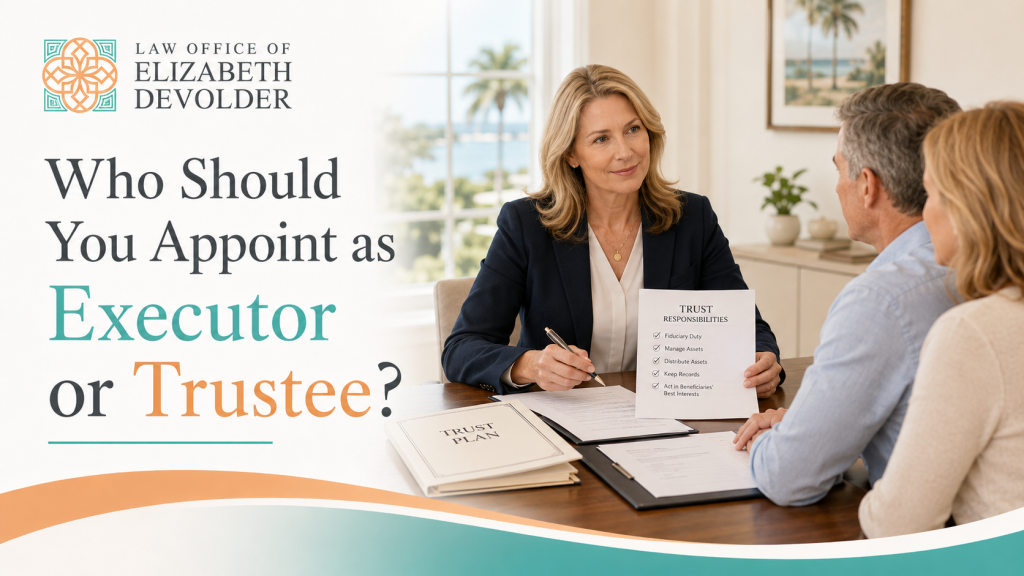
Who Should You Appoint as Executor or Trustee?

As you're planning out your estate, it's important to choose trustworthy, qualified people to be the executor of your estate and the successor trustee to any trusts you manage. A Tampa, FL wills lawyer can help you create ironclad documents that will set all this up and give you advice on your choices for executor and trustee. more The Roles of an Executor and a Trustee An executor is the person who steps in after your death to manage your will as it goes through the probate process. In Florida, this person is called the personal representative. They gather your assets, pay any debts and taxes, file all the necessary paperwork with the court, and distribute what remains of your estate after debts and taxes exactly as you direct in the will. Their role ends once the estate is settled. A trustee manages assets you have placed in a trust. If you create a revocable living trust, you may serve as trustee while alive, and, after your passing, the successor trustee takes over and follows the trust instructions you have set up. This could mean continuing the trust and making investments, or it could mean making distributions to beneficiaries, and it will also involve handling taxes. A trustee may be "on duty" for many years, depending on the trust. Your trustee can also be your executor, or you can put different people into the roles. Essential Qualities to Look For Honest Obviously, honesty and integrity are the number one concerns. The people you choose will have full access to your financial accounts and personal information, so they must be totally trustworthy and ready and willing to put your wishes and your family's needs ahead of any personal gain. Organized Organization matters a great deal in these roles. These jobs include keeping track of deadlines, paperwork, and every asset down to the last detail. If someone loves you and is completely trustworthy, but they are disorganized and scattered, they aren't going to be a good choice. Qualified Financial responsibility helps, but the person you choose does not need to be an expert. That's because your trustee or executor can always hire accountants or attorneys when needed. What they do need is the willingness to seek proper help and keep accurate records. Choosing Family Members or Friends Many people name a spouse, adult child, or close friend because these individuals already know their values and family dynamics. At the same time, family members sometimes lack the experience needed or may be unable to put aside their grief, family relationship strain, or other issues to do the job well. Sometimes it makes better sense to hire a professional. Talk with a Tampa, FL Wills Lawyer Choosing the right executor or trustee will give you confidence that your wishes will be followed and your family will be protected. For experienced advice and help in the context of Florida law, call the Law Office of Elizabeth Devolder in Tampa, FL today at 813-379-9839. We also serve clients in the Sarasota area.

Handsome old man and beautiful woman are discussing house project and smiling while sitting on couch at home

What Legal Tools Help Plan for Incapacity?

It's not easy to think about a time when you might be unable to make decisions about your life and finances, but if you plan for the possibility now, you'll be able to face the future with better peace of mind. Your Tampa, FL estate planning lawyer can help you create the documents you need to protect your wishes and give direction to your loved ones. more Legal Tools to Plan for Incapacity Incapacity can arise very suddenly, and, without preparation, the people closest to you may lack the power to pay your bills, authorize treatment, or manage your property even when they know exactly what you'd want and have your best interests at heart. You can give them the tools they need with some of the following documents: Durable Powers of Attorney A durable power of attorney gives control over your financial and legal matters to someone you trust when you can no longer manage them yourself. You designate an agent to handle tasks ranging from writing checks and filing taxes to selling real estate or accessing retirement accounts. You execute this document while you're fully capable, and you may grant as broad or as limited powers as you like, depending on how much discretion you wish to provide. Many people name a spouse or adult child as their primary agent and designate an alternate in case the first choice becomes unavailable, but always talk over your choice with your lawyer and consider carefully whether the chosen individual has the financial literacy and temperament to handle complex matters under stress. Health Care Directives There are two complementary advance directives that together allow you to both appoint a decision-maker on your behalf and state your preferences for treatment to guide them. Your health care surrogate should be a trusted adult who can consent to or refuse procedures for you, access your medical records, and apply for benefits on your behalf once your primary physician determines that you lack the capacity to make these decisions yourself. A living will, meanwhile, gives direct instructions to physicians and also guides your health care surrogate. In this document, you declare in advance that if you suffer a terminal condition, an end-stage condition, or a persistent vegetative state with no reasonable chance of recovery, life-prolonging procedures should or should not be withheld or withdrawn. Any instructions you give while still capable supersede those of your surrogate, so you always have ultimate authority over your own life. Avoiding Guardianship If you don't make all the proper plans in advance, the Florida courts may appoint a guardian of the person and a guardian of the property if you become incapacitated. This involves hlding a hearing to prove your incapacity, which can be traumatic and diffiucult for your loved ones, and neither they nor you will have the ultimate say in who has control of your estate or your healthcare. Talk to a Tampa Estate Planning Lawyer Put the right legal tools in place now and you're taking an important step toward securing your future autonomy. Contact the Law Office of Elizabeth Devolder in Tampa or Sarasota now to get started.

Woman with mortuary urn and lily flower on light background looking for a Probate Attorney in Tampa, FL

What Should You Expect From the Probate Process?

Probate is a process for handling the estate of a deceased person, and the goal is to make sure all the assets of an estate are legally and fairly transferred in accordance with the wishes of the decedent. But the process can be time-consuming and difficult, particularly if there is no will or there are contests to the will. A Tampa, FL probate attorney can help you and your family get through the probate process as smoothly as possible. more What to Expect From the Tampa, FL Probate Process Assets that Go Through Probate The Florida Probate Code sets out the process, and all assets that were owned by the decedent, including bank accounts, retirement accounts, personal property, and real estate, go through probate unless they're protected in some way. For example, bank accounts that have named beneficiaries go directly to that beneficiary upon the death of the account holder, and life insurance with named beneficiaries also doesn't go through probate, either. Anything in a trust usually bypasses probate, as well. Types of Probate Administration Florida offers two types of probate: Summary Administration This is a simplified, faster process, but it is only for smaller estates where the total value of probate assets, excluding the homestead property, is $75,000 or less, or if the decedent has been deceased for more than two years. No personal representative is appointed in this process, and it often skips many of the formal steps included in the process for bigger estates. Formal Administration This process is for all larger and more complicated states. The personal representative or executor of the estate will work under the court's supervision to itemize, value, and distribute all the assets while also paying all taxes and debts. If there is no one named in the will, then the court will appoint an executor or administrator. Key Steps in the Probate Process Filing the Petition: You start by filing a petition in the probate court in the county where the decedent lived. Validation and Appointment: The court validates the will and appoints an executor. Notification: The executor identifies all interested parties (natural heirs, named beneficiaries, and creditors) and notifies them that probate has begun. Inventory and Appraisal: The executor gathers and inventories all assets and gets appraisals for items like real estate. Handling Debts and Claims: The executor pays all valid debts and taxes. If there aren't enough liquid assets to pay for all this, some assets may be sold. Distribution of Assets: Once debts and taxes are settled, all the remaining assets are distributed according to the will or (if there is no will) according to state law. Talk to a Probate Attorney Whether you are in the middle of the process or are hoping to plan your estate in such a way as to help your loved ones avoid probate as much as possible, get experienced help from the Law Office of Elizabeth Devolder by calling 813-379-9839 in Tampa or 941-337-0624 in Sarasota today.

How Do Special Needs Trusts Work, and Who Needs One?

Call us today at 813-379-9839 for a consultation on special needs trusts, or visit our Contact Us page for more information. Families with loved ones who have disabilities often face the challenge of balancing financial security with the need to maintain eligibility for government benefits. A Special Needs Trust (SNT) can offer an effective solution, ensuring that your loved one’s quality of life is enhanced without risking critical benefits like Supplemental Security Income (SSI) or Medicaid. If you're in Tampa, FL, and need guidance on setting up a Special Needs Trust, our expert attorneys at the Law Office of Elizabeth Devolder are ready to help. more What is a Special Needs Trust? A Special Needs Trust (SNT), also known as a Supplemental Needs Trust, is a legal arrangement that holds and manages assets for individuals with disabilities. This type of trust ensures that funds are used to enhance the life of the beneficiary while keeping them eligible for crucial government programs. The trust is managed by a trustee often a family member who uses the assets to pay for things like special medical treatments, educational expenses, personal care, or recreational activities that government benefits don’t cover. The most significant advantage of a Special Needs Trust is that it protects eligibility for public benefits. Since the beneficiary does not have direct control over the trust's assets, these assets are not counted toward the government’s resource limits. This means that even if the beneficiary’s trust holds significant funds, they won’t lose eligibility for programs like SSI or Medicaid. This distinction is essential, as many government programs have strict asset limits (often no more than $2,000 in countable assets for individuals), and direct gifts or inheritances could disqualify a loved one from these benefits. How Does a Special Needs Trust Work? Special Needs Trusts must adhere to federal regulations under the Social Security Act and local state laws. Importantly, they are typically irrevocable, meaning they cannot be easily modified or canceled after creation. The trustee has discretion over how the funds are distributed but must follow specific guidelines to ensure that the distributions do not jeopardize the beneficiary’s eligibility for public benefits. For example, using the funds to pay for food or shelter directly can reduce the recipient's SSI benefits. For the trustee, this responsibility means they must be well-versed in both the needs of the beneficiary and the legal framework surrounding government benefits. This careful balance between providing for your loved one and preserving their eligibility for essential benefits makes having a knowledgeable attorney an invaluable part of the process. Need help navigating these complex regulations? Contact the Law Office of Elizabeth Devolder in Tampa, FL, at 813-379-9839 or visit our Contact Us page to speak with an expert Special Needs Planning attorney. Who Can Benefit from a Special Needs Trust? A Special Needs Trust is ideal for individuals with disabilities who rely on or may need needs-based government benefits like SSI or Medicaid. Common scenarios where families often consider creating a Special Needs Trust include: Parents of children with autism, Down syndrome, cerebral palsy, or other developmental disabilities who require long-term care and may have limited future earning potential. Accident victims or individuals with life-altering injuries who receive a significant settlement but still require ongoing Medicaid for health care and rehabilitation. Families concerned about leaving an inheritance or gift that could disqualify a relative from essential programs like SSI or Medicaid. Not everyone needs a Special Needs Trust. For example, if the beneficiary’s assets are low and they do not rely on government assistance, other simpler estate planning tools may be sufficient. However, for larger sums or long-term financial security, Special Needs Trusts are an essential tool to ensure your loved one’s future is secure without compromising vital support from public benefits. To discuss how a Special Needs Trust can help protect your loved one’s benefits and future, contact our office today at 813-379-9839 or visit our Contact Us page. Why Choose Our Tampa, FL Special Needs Planning Attorneys? At the Law Office of Elizabeth Devolder, we specialize in Special Needs Planning, Trust Administration, and Estate Planning. We work with families in Tampa, Sarasota, and surrounding areas to ensure their loved ones with disabilities are cared for and that their financial needs are met without jeopardizing eligibility for government benefits. Contact us at 813-379-9839 for a personalized consultation, or visit our Contact Us page to schedule an appointment. We can also assist with Trust Administration and all aspects of Special Needs Law to provide peace of mind for you and your family. For more information on managing trusts, read about our Trust Administration services. FAQs About Special Needs Trusts 1. What is the difference between a Special Needs Trust and a regular trust? A regular trust is a financial arrangement where assets are held by a trustee for the benefit of the beneficiary. However, a Special Needs Trust is specifically designed to preserve the beneficiary’s eligibility for government benefits, such as SSI or Medicaid. Regular trusts may count toward the beneficiary’s asset limit, while the assets in an SNT do not. 2. Can a Special Needs Trust be changed? Once established, most Special Needs Trusts are irrevocable, meaning they cannot be easily modified or canceled. This ensures that the trust’s purpose protecting eligibility for benefits remains intact. However, in some cases, a trust amendment may be possible, depending on the specific circumstances and the law. 3. Can I leave money directly to my child with a disability? While it’s tempting to leave assets directly to a loved one with a disability, doing so could jeopardize their eligibility for needs-based government benefits. Instead, a Special Needs Trust allows you to provide financial support without affecting their eligibility for programs like SSI and Medicaid. Consult with an attorney to determine the best course of action for your family. 4. How does a Special Needs Trust affect SSI or Medicaid? A Special Needs Trust helps ensure that the assets in the trust are not counted as part of the beneficiary’s total assets when calculating eligibility for programs like SSI or Medicaid. This means the beneficiary can receive the benefits they need while also benefiting from trust assets that enhance their quality of life. 5. What can a Special Needs Trust be used for? The trust funds can be used for anything that improves the beneficiary’s quality of life, as long as it doesn’t affect government benefits. This includes things like medical equipment not covered by insurance, therapies, education, recreation, travel, and personal care items that are not provided by public benefits. 6. How do I get started with a Special Needs Trust? To begin setting up a Special Needs Trust, you need to consult with a Special Needs Planning Attorney. Our team at the Law Office of Elizabeth Devolder specializes in this area and can guide you through the process. Contact us at 813-379-9839 or visit our Contact Us page to get started. Ready to protect your loved one’s future? Reach out to us today 813-379-9839 to get started on creating a Special Needs Trust that secures your family’s future while preserving their eligibility for essential benefits.

Can a Trust Help Avoid Probate?

A trust can indeed be a great way to avoid probate. To do so, however, it must be set up correctly, and your Tampa, FL trust lawyer can make sure things are done legally and exactly according to your wishes. more How a Trust Avoids Probate When you set up a trust, you are essentially creating a legal entity in which to put some of your assets. Once you transfer assets from your direct and immediate control as part of your estate into the trust, they are no longer owned by you. They are owned by the trust. When you pass away, all the assets of your estate have to go through probate, but since the assets you put in the trust are owned by the trust, and the trust did not "die," nothing in the trust goes through probate. In most cases, you will name yourself as trustee of the trust, which means you still have control of the assets. You will also establish a successor trustee who will take over if you become incapacitated or when you pass away, and your passing away is the trigger event (in most cases) for the trust to be dispersed in the manner you've set up. Types of Trusts The Revocable Living Trust This is the most popular option for the average person and estate. Most commonly, you would appoint yourself as the trustee of this trust so that you keep full control. You can revoke this trust at any time while you're still alive, or you can change or amend it. However, the assets in this trust remain part of your estate for tax purposes and have some vulnerability if a lawsuit is brought against your estate. The Irrevocable Trust This trust also avoids probate for the reasons given above, but these trusts cannot be changed once they're made. They offer greater tax benefits and more creditor protections, but they are very inflexible. There are other types of trusts that are useful in specific situations. A lawyer can tell you more. Best Practices for Setting up a Trust Talk to a Tampa, FL Trust Lawyer Most people will find the technicalities and legalities surrounding trusts to be difficult to work through. Your lawyer will know all the rules and how to ensure your trust is set up properly. An experienced attorney will also be able to tell you all the trust options and help you choose the best ones for your family and estate. Don't Forget to Review Many people set up a revocable living trust and then forget about it. It's important not to do this: it needs to be reviewed periodically and definitely after any major life change, such as the birth of a new child, a death in the family, divorce, or marriage. You may also need to review it if there's a major change to your financial circumstances. To learn more about trust and what's best for you, contact the Law Office of Elizabeth Devolder in Tampa or Sarasota today.

What Are Your Options for Asset Protection Before Retirement?

Most of us look forward to retirement, but if you're going to really enjoy those golden years, it's important to make sure your assets are protected so you don't burn through them faster than expected. An asset protection lawyer in Tampa, FL can help you set things up in a way that will ensure your future is secure. more From a Tampa, FL Asset Protection Lawyer: Getting Protected Before You Retire The precise steps you take will depend on your unique situation, so this is something you need to talk over with a lawyer in person. But in general there are some basic steps that you'll probably want to take: 1. Establish Trusts When you create a trust, you transfer some of your assets from your own estate and into the trust. Those assets now do not technically belong to you: they belong to the trust. You can set yourself as the trustee or have another trustee appointed, and you can still manage how assets in the trust are used. There are several types of trusts, but the two large, overarching types are revocable and irrevocable. Revocable trusts offer you more flexibility to change things, but they offer fewer protections. Irrevocable trusts offer more protection but are less flexible once they've been set up. A lawyer can help you decide the best choice for you. 2. Diversify It's always wise to diversify your investments as you try to build wealth and look towards your retirement years. Every type of investment, from stocks and bonds to real estate, gold, or even crypto, comes with its own risk profile and rewards. If you have, as they say, "all your eggs in one basket," you're taking on too much risk. If everything you have is in the stock market, for example, and the stock market tanks at the wrong time, your retirement could be endangered. By diversifying as much as possible, it's more likely your retirement income will stay stable. 3. Be Smart About Insurance Coverage Insurance is something you can pay into now and reap big benefits from when you hit retirement. Healthcare is always a huge issue to be concerned about. For one thing, you just don't know how many years of life you might have, so you don't really know how many years of retirement you're going to need to plan for. For another, should you end up needing serious long-term care, you could easily burn through all your assets. Consider getting long-term care insurance and disability insurance to get peace of mind for all this. The right life insurance policy can also be helpful. With some life insurance policies, you can choose cash out the policy under the right circumstances, and that gives you an extra source of money should you be hit with something unexpected. These are just a few of the options that can protect your assets as you head into your golden years, but the best thing that you can do to prepare is to talk with an experienced attorney. Contact the Law Office of Elizabeth Devolder in Tampa, FL today.

How Can an Elder Law Attorney Help With Long-Term Care Planning?

As Florida's population ages, effective long-term care planning has never been more important. The average annual cost for a private nursing home room now exceeds $108,000, and even assisted living hovers at around $54,000. Those prices are only going to go up, and they can quickly deplete a whole life's savings unless you're properly prepared. An elder law attorney in Tampa, FL can help you make sure you are. more How Can a Tampa, FL Elder Law Attorney Help With Long-Term Care Planning? Assessing Your Individual Circumstances It all begins with assessing your individual circumstances from a place of knowledge and experience. Some of the important things to consider include your health status, financial resources, and family support. With a thorough evaluation, we can forecast your potential care requirements, guide you through housing options, help you look at all the alternatives, like long-term care insurance, and more. Your Medicaid Advocate Medicaid is often the primary payer for long-term care, but it comes with strict eligibility criteria. To qualify, you must have very little in countable assets and income, and it's easy to get in a situation where all your assets and income are simply eaten away. Elder law attorneys can help you with preemptive planning that allows you to achieve eligibility without having to "spend down" all your assets unnecessarily. They can help you get past the five-year look-back period, where improper asset transfers (like gifting money to your family) could trigger penalties that delay or deny your benefits. Your lawyer will also handle all your applications, any appeals that are necessary, and make sure everything is done in compliance with Florida's rules. Asset Protection Without planning, your long-term care costs could completely erode your estate and leave nothing for your loved ones. An attorney knows all the right legal tools to safeguard your wealth for your heirs while allowing you to still qualify for benefits. These might include establishing irrevocable trusts, revocable living trusts, engaging in the right gifting strategies, or even creating first-party, third-party, or pooled special needs trusts to preserve your eligibility for Supplemental Security Income (SSI) or Medicaid. Drafting All Documents There's a lot of paperwork that goes into properly setting up your long-term care plan, and your attorney will make sure nothing is missed and that everything is created and filed properly. You might need everything from a Durable Power of Attorney to various advanced directives for end-of-life preferences, DNR orders, or Physician Orders for Life-Sustaining Treatment (POLST). Your will and any trusts also need to stay updated regularly so they continue to reflect your wishes, and then they may need to be changed if there are any big changes to your circumstances. There's a lot more that a lawyer can do to help, so contact the Law Office of Elizabeth Devolder in Tampa, FL today ​to talk with ​an experienced ​attorney. Whether you need to do estate planning, trust administration, guardianship, litigation, or more, we have the experience you need in Tampa and Sarasota.

What Happens During Probate Litigation?

During probate, a deceased person's estate is dealt with according to the Florida Probate Code. The deceased person's personal representative inventories the estate and determines its value, pays off debts and taxes, and then transfers the estate to the beneficiaries. At any point in this process, challenges can arise, and sometimes litigation is unavoidable. A Tampa, FL probate litigation attorney can help you bring a case or defend against litigation. more From a Tampa, FL Probate Litigation Attorney: About Litigation In the context of probate, the most common disputes are over whether the will is valid, how the estate is being administered by the executor, or how the terms of the will should be interpreted. Anyone who has a stake in the estate can bring a claim, so this is usually beneficiaries, executors, creditors, or anyone who would legally be eligible as an heir of the estate, even if the will doesn't name them as a beneficiary. Just because a person thinks they should have been in a will and brings a litigation challenge doesn't mean the court will hear it, of course, but those with a stake in the estate have the right to try if they can bring a case to show there's a problem with the will. Probate Litigation Process A case begins when one of the interested parties files a petition with the court. This will summarize what they are claiming or objecting to. The court will then decide whether to hold a hearing, and if it does, the next step will be a summons. The court will send legal notices to all interested parties telling them about the pending litigation and informing them of their rights and obligations. There will then be hearings, but in preparation for the hearings, both sides first engage in discovery and make motions. Discovery is where both sides gather evidence. Both sides can also bring motions to request the court to rule on certain things or take specific actions. The court may also order the parties to enter into mediation at this point.After discovery is finished, there will be a trial, at which both parties can present their evidence and use it to make arguments. The court will make a final decision if no agreement is reached in mediation, and the court's decision is binding. The goal of the court will be to resolve the dispute while making sure that the deceased person's wishes are followed. Wherever you are in the process, we can help. We can help you with estate planning that will protect your beneficiaries from litigation to a large degree and put certain elements in place to discourage anyone from bringing a challenge to your will. If you're currently in a battle, we have many years of experience in Florida's probate courts and a determination to fight hard for our clients. Reach out to the Law Office of Elizabeth Devolder in Tampa or Lakewood Ranch, FL today to schedule an appointment. chat

When Does It Make Sense to Create a Trust?

A trust can be a powerful tool to protect your assets. It often makes sense to create one, but there are also situations where trust is not your best tool. A trust attorney in Tampa, FL can tell you the benefits of a trust and when they're most useful under Florida law. more When Does It Make Sense to Create a Trust? 1. You Become Incapacitated Anyone can become unexpectedly incapacitated, of course, but a trust is a particularly wise move if you know that incapacitation is a greater risk for you than it might be for others. For example, if dementia runs in your family or if you have been diagnosed with a slow-onset condition and know that eventually you'll be less able to manage your affairs, now might be the perfect time to create a trust with a successor trustee in place. You can continue to control your assets as long as you're able to, and once you become incapacitated, you won't even necessarily have to be declared incompetent before the successor trustee can take over. The transfer is smooth, and you get invaluable peace of mind. 2. You Have Assets You Don't Want to Go Through Probate Probate is a long and involved, costly process. All the assets that go through probate are unavailable to your family until the probate process is finished. A trust can protect your assets from this probate process, and it's important to talk with a lawyer about the best type of trust for your intentions. With some trusts, the probate process can be avoided, but the assets in the trust can still be vulnerable if you have a lot of debt or there's a possibility of a lawsuit after your death. Other trusts offer more protection from taxes and debts but give you less flexibility to control the assets during your lifetime. 3. You Want to Control Asset Distribution If you have reason to believe you won't be living much longer, and even if you have no such diagnosis but are just concerned about the possibility of passing away before your children are old enough to have learned how to manage money well, creating a trust can give you confidence that your assets will be distributed to the beneficiaries on your terms. If you don't have a trust in place, then your beneficiaries will simply be given everything that is left to them in the will. That may be fine, but if you want to avoid leaving a huge payout to a very young adult who might not be mature enough to handle that much, putting it into a trust can allow you to have it dispersed to them throughout their lives at various intervals or specifically disbursed only for important expenses, such as buying a home, getting an education, or paying medical bills. Talk to a Tampa, FL Trust Attorney Today For more about whether a trust is right for you or not, contact the Law Office of Elizabeth Devolder in Tampa, FL today, and let's talk about how to protect your family.

Contact Us

Fill out this form below and we'll contact you shortly
*Required Fields